


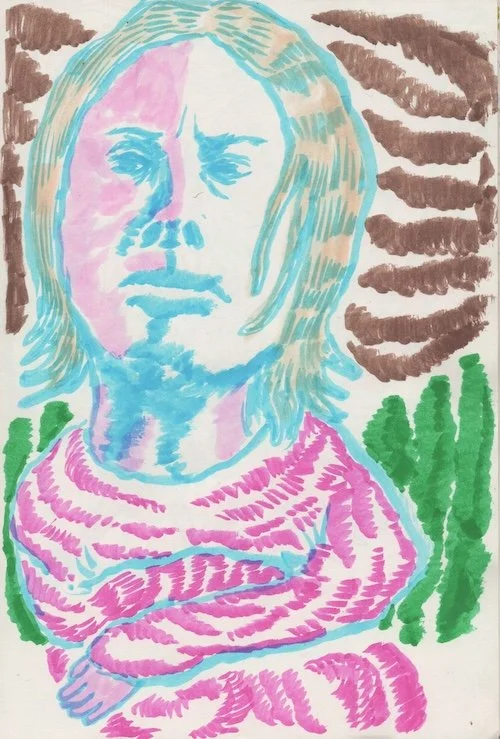
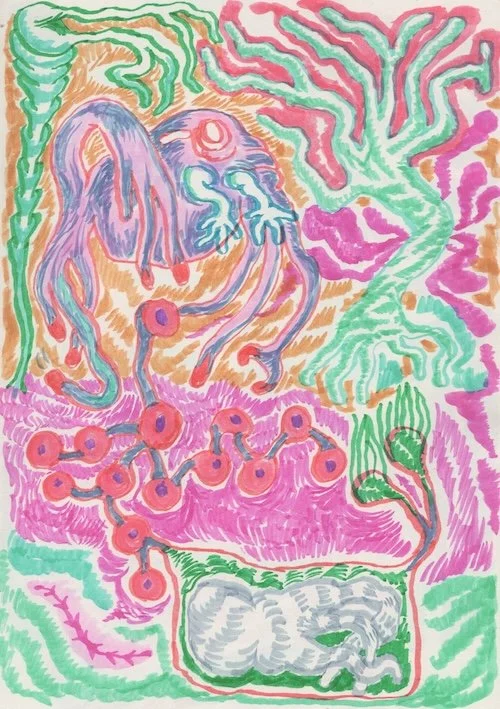
DT: You make all of the artwork for your releases as Otto Benson yourself… Can you describe your painting practice — materials, scale, pace, etc. – in one sentence.
DT: When I first heard that you create all of the art for your releases I Immediately thought of makers like Daniel Johnston and Patti Smith, who made really unique paintings and drawings while also being sonically innovative. Do you approach painting as a separate discipline from songwriting, or do you think of both as two parts of a single creative process?
Otto: I enjoy materializing and sharing my dreams, prayers, memories, and emotions with cheap, up-cycled, and commonly accessible materials.
Otto: I see it all as a single process. I like to think of these different mediums as just different spectrums of waves to emit on. To me, even the burgers Daniel Johnston was likely flipping at McDonalds are a part of his paintings, or Patti Smith’s New York. Everything colors everything else.
DT: In that same vein, I was recently talking to someone about the Outsider Art Fair in New York. It’s a fair dedicated to the self-taught and proverbial Other’s of the art world; the best way to sum it up probably being that if Daniel Johnston were still alive he’d be exhibiting there. Looking at some of the work on view made me think of the art that you make - both the sentiment of it and the perceived ethos. Do you think of yourself as a different or “Outsider” artist because your work/ career as a painter and draughtsman isn’t traditional? Also, are you self-taught?
Otto: I don’t feel outside. I have had lots of friends, teachers, privileged experiences, and access that to me feels “inside” and exclusive. But so does everyone in their own way. Do you think that the inside/outside distinction has to do with whether or not things are motivated by money or just pure artmaking for artmaking’s sake? I try to aspire for the latter but I, too, live in America and want to buy a piece of land and a tractor and to grow giant zucchinis. One of my favorite art institutions is AVAM in Baltimore, MD. They have a very resonant and inclusive way of describing “visionary art,” which I think expands beyond the “outsider” label.
From their website: "Visionary art as defined for the purposes of the American Visionary Art Museum refers to art produced by self-taught individuals, usually without formal training, whose works arise from an innate personal vision that revels foremost in the creative act itself."
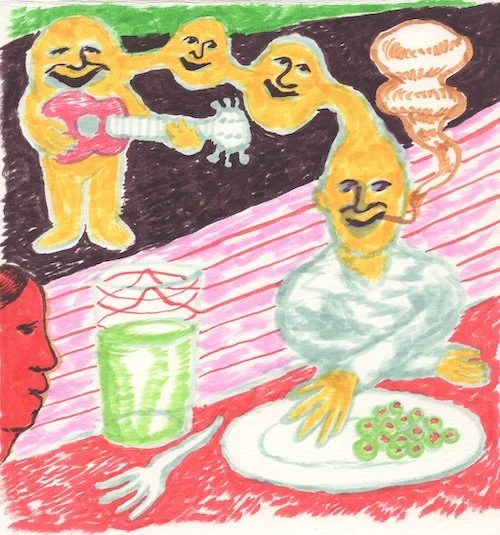
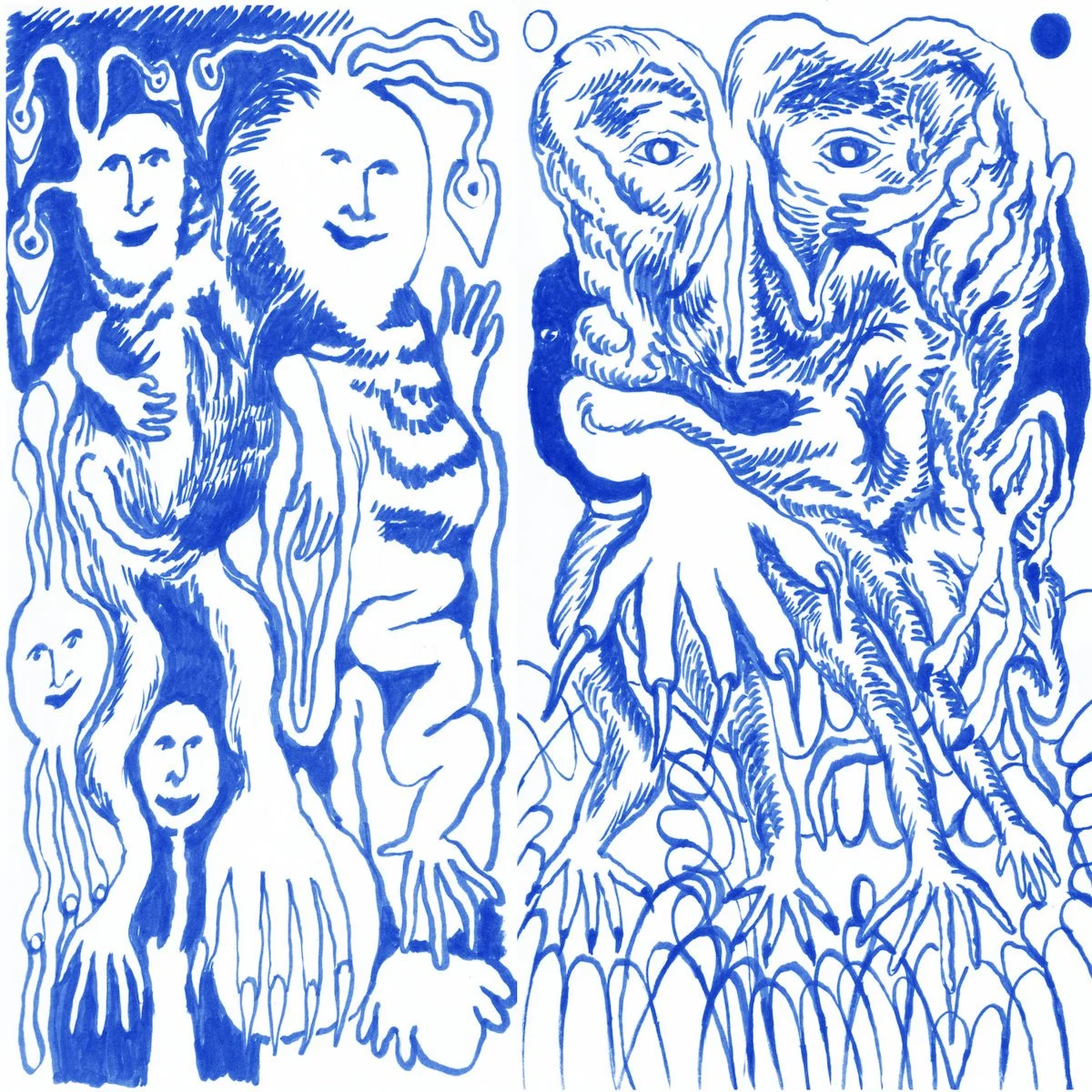
DT: Have you read Dante’s Inferno? Your drawings from your 2022 releases make me think of the bottom four circles of hell. Also, almost everyone’s smiling. Is there something to this?
Otto: I am interested in Dante’s Inferno. I resonate a lot with that physical structure for hell, the concentric descent, and satan waiting in the pit. I structured my first website that I made in high school off of Dante’s Inferno. It has burrowing pages of crude choose-your-own-adventure stories. I made it when I felt pretty furious at the world around me and I just wanted to dig my own little hell to scream into. And then I covered it up when I felt better. The faces though are more about embodying things or respecting objects, emotions, whatever as you would a person. I find it fulfilling to treat things like people, letting their personality shine, taking care of them. “Mother Earth” is a common example of how people do this. I’m just trying to extend it further with my drawings. “Sister Nausea.” “Mr. Drainage Pipe.” “Brother Earwax Removal Kit.”
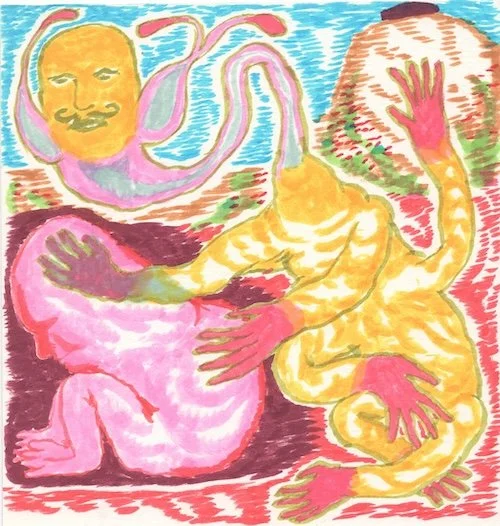
DT: Your art falls into a unique category for me. It’s way too referential to be “primitivist.” I hate this term. It’s also too self-aware to be part of the “naïve” genre. It’s full of abstracted figures but also feels misrepresentational, if that makes any sense. Every painting’s pretty odd yet clearly part of a carefully constructed world. How would you describe your style? Or Is there a name or ascription you’d give it if you were an art historian?
Otto: It makes sense to me that the work feels that way. I find a lot of my inspiration from artworks made about spiritual/divine experiences but by ordinary people without the inhibitions of some formal technique. When I’m working on something, I usually want to convey a feeling or materialize something that I don’t understand. But the technique, while it’s great to practice and refine, is generally not as important to me as just finding and revealing that weird subconscious truth.
I don’t want to call it “spiritual” or “outsider” or anything for that matter. Naming it feels sacrilegious, pushing away everything else that it could be. I’m trying to sit in and enjoy the confusion. I usually just tell people I make “records,” “music,” or “drawings” and leave them with that.
DT: Is there a shared rhythm or structure between how you compose a song and how you build an image?
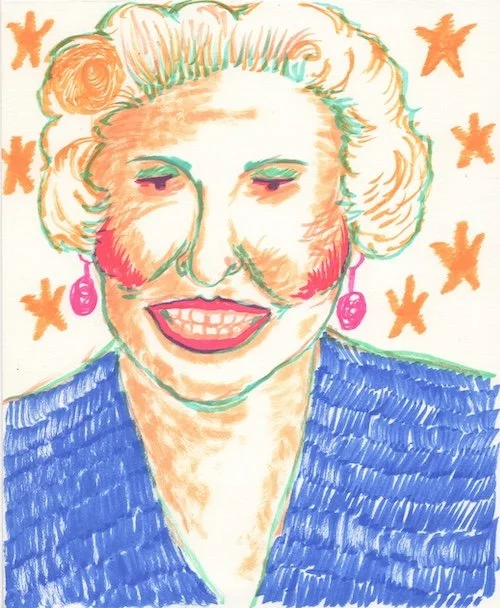
Otto: It pushes and pulls from both directions. Sometimes I’m drawing and then making music about the drawing or other times I’m sitting down to make an album cover about some music. The shared structure is mostly that I’m limited by my environment, circumstances, and materials available to me. Sometimes I’m home during a quiet time of day and able to work through a song or other times I’m doodling on a stoop waiting to meet someone. It’s just what I can make when I can make it.
DT: Some of your collaborations with other artists (Mietze Conte, Musique Chienne, etc.) aren’t represented by paintings at all, but by a really interesting kind of digital collage art. They seem to speak the same pictorial language as the images you make for your personal output, but are so different in their presentation. You have a degree in engineering and you’ve spoken about your interest in mechanization and digital production before - does this kind of graphic design, because it finds its basis in the computer chip, feel closer to the act of making music for you?
Otto: Computers have a beautiful and specific transistorized character. And also hand crafts have their own sound and character, which over time has become the most exciting and fulfilling to me. But I just think it creates a nice immersion to have digital sounding music released with digital art or hand painted paintings with hand played guitar music.
The songs I made with Musique Chienne and Mietze Conte were made on the computer, fully embracing the digital palette, so it felt fitting to accompany them with similarly constructed digital artworks. Although, I think the act of making music (or art) has nothing to do with technology. You can think about music digitally through the abstractions of computers and math, or the frets of the guitar. But the heart of the process exists between your mind, your body, your ears, the pressure of the air around you, and maybe whoever else is listening. Everything else doesn’t really matter. I find that comforting, especially in the current technological context of AI, etc.
DT: Who are some visual artists or designers that you like?
Otto: Oh too many. I love Michael Hurley a lot. Joyce J. Scott. Children's art – I love when it’s exhibited in a public space like a train station. Harrison Wyrick; my buddy who makes really beautiful and funny animations, Arius Ziaee is another buddy of mine from the West Coast who recently taught me how to make looping animations. Josh Cloud, Kate Renshaw Lewis, R. Crumb, the amazing transdisciplinary genius Cal Fish, my friend Charley who makes ridiculous films with old cameras and hacked WWE wrestling games – Marcel Dzama, Paul McCarthy… there are too many for my little mind.
DT: Do you plan to exhibit any of your visual work in a context that doesn’t include your musical output?
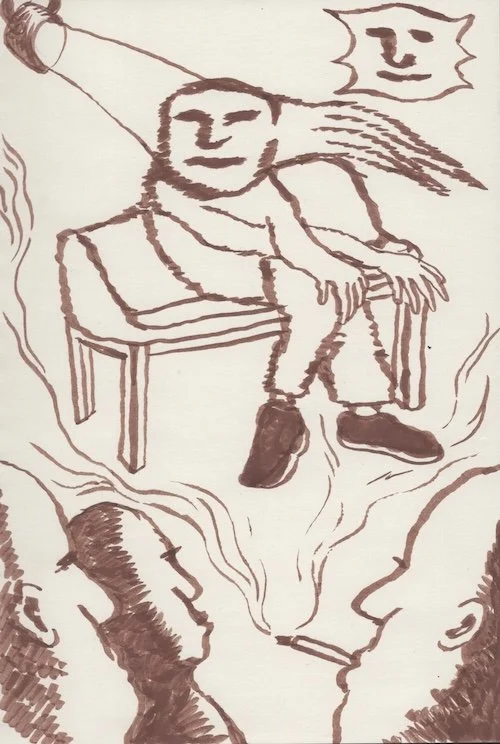
Otto: It might be nice to have a bunch of drawings on the wall of a white box gallery and have a nice opening party and serve fruit to attendees. Any excuse to gather and cultivate community these days. But I’m also pretty interested in making art books or animations or installing musical robotics and electronics projects in appropriate longer-term or public spaces.
This interview was conducted by Ano Chrispin for the Inaugural issue of Drafting Table. Available both online and in print.